
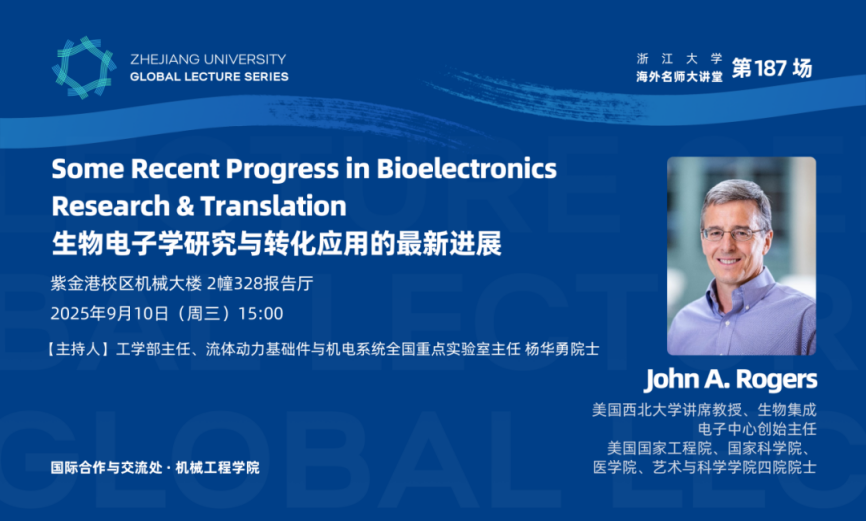
On the afternoon of September 10, the Zhejiang University Overseas Distinguished Scholars Lecture Series, jointly held with the Forum on Mechanical Science and Engineering Advancement, the M.E. Global Seminar Series, and the “Medicine-Engineering-Information Interdisciplinary Forum,” took place at Kaiwu Garden, Zijingang Campus.
This event was co-organized by Zhejiang University’s Office of International Cooperation and Exchange, School of Mechanical Engineering, State Key Laboratory of Fluid Power and Mechatronic Systems, the journal *Bio-Design and Manufacturing*, and the College of Pharmaceutical Sciences. Over 300 faculty members and students from more than 20 university departments—including the School of Mechanical Engineering, College of Control Science and Engineering, College of Chemical and Biological Engineering, School of Computer Science, and School of Medicine—attended the event.
The seminar featured a distinguished keynote lecture by Professor John A. Rogers, Chair Professor at Northwestern University and a member of all four U.S. National Academies—the National Academy of Engineering, the National Academy of Sciences, the National Academy of Medicine, and the American Academy of Arts and Sciences. The lecture was chaired by Academician Yang Huayong, Director of the Faculty of Engineering at Zhejiang University and member of the Chinese Academy of Engineering.
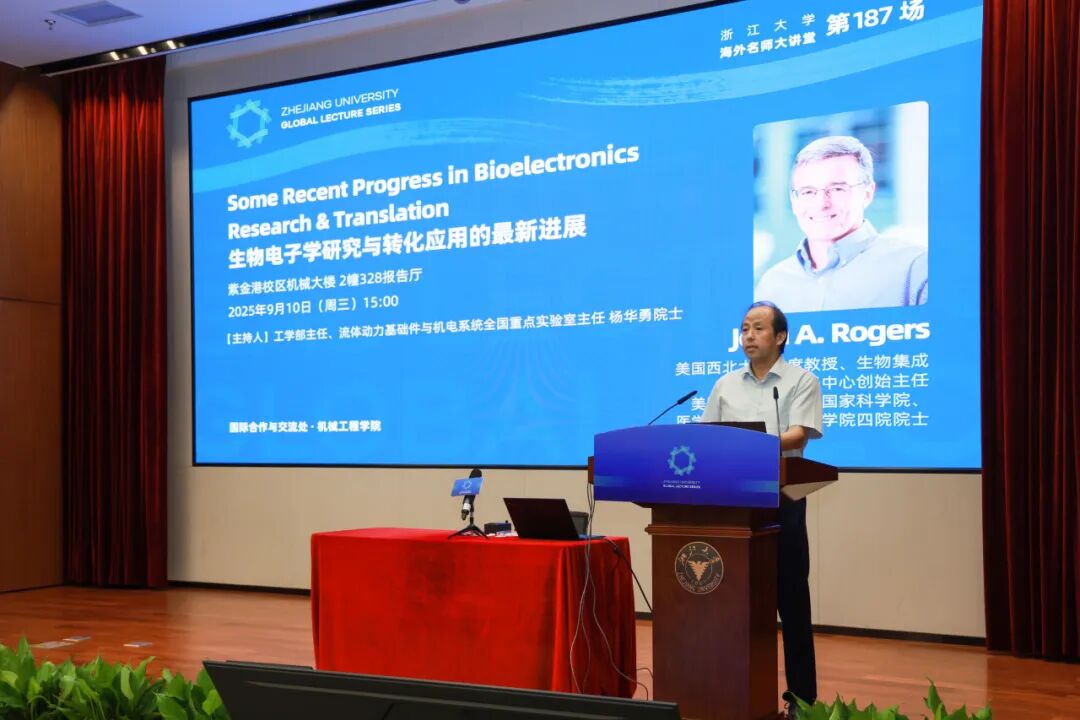
Academician Yang Huayong delivered the opening remarks for the lecture and introduced the distinguished guests in attendance. Following this, Academician John A. Rogers presented a lecture titled “Recent Advances and Translational Research in Bioelectronics,” offering students an interdisciplinary, cutting-edge, and multidimensional academic presentation.
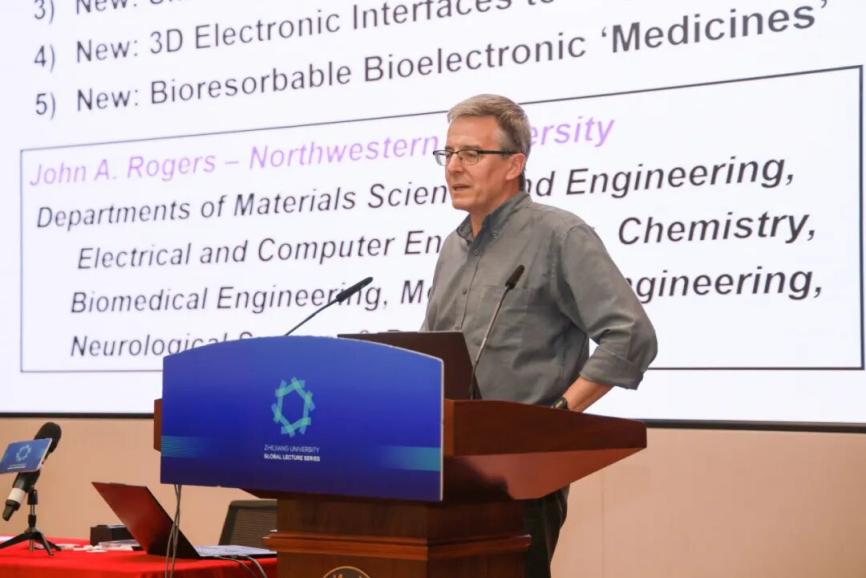
During his nearly two-hour lecture, Academician Rogers systematically presented the latest advances in flexible bioelectronic devices in both research and clinical applications, drawing on his team’s extensive research over many years. He emphasized that these electronic devices can conform closely to the body’s soft tissues, offering novel approaches for health monitoring and disease treatment.
The talk highlighted several representative achievements:
- **“Electronic tattoos”** that adhere to the skin can non-invasively record physiological signals such as electrocardiograms (ECG), body temperature, and respiration. These devices have already been deployed in neonatal intensive care units and have received FDA approval for global distribution across numerous countries and regions.
- A **sweat-based microfluidic sensing platform** enables real-time monitoring of biochemical markers—including lactate, chloride ions, glucose, and pH. Some of these technologies have been commercialized into sports-monitoring products, and are also being explored for applications in kidney health assessment.
- The team’s **latest research on skin-mounted gas sensors** offers a new method for monitoring wound healing and providing early warnings of infection.
- Their **3D flexible electronic scaffolds**, which integrate with tissues such as brain organoids through mechanical strain, can record and modulate complex physiological activities—thereby supporting drug screening and disease modeling.
- Additionally, the team developed the **world’s first fully bioresorbable cardiac pacemaker**, which safely provides temporary postoperative cardiac regulation without requiring surgical removal. This innovation eliminates the risks associated with secondary surgeries and represents a major breakthrough.
Academician Rogers stressed that scientific research should not only pursue academic excellence but also drive translational impact—bridging the gap from “the end of a research paper” to “the beginning of a practical technology”—to meet real clinical needs and serve societal development.
Looking ahead, he noted that flexible bioelectronics will continue evolving toward greater **flexibility, three-dimensionality, non-invasiveness, and biodegradability**, playing a pivotal role in personalized medicine and next-generation therapeutic paradigms.
The lecture was rich in content yet remarkably accessible, vividly showcasing the dynamism and allure of cutting-edge science while offering valuable insights into interdisciplinary integration and industrial translation.
During the Q&A session, numerous faculty members and graduate students engaged in in-depth discussions with Academician Rogers, posing questions aligned with their own research interests. Academician Rogers provided thorough and expert responses to each inquiry and offered thought-provoking insights into future research directions. The session was marked by active participation, a vibrant atmosphere, and highly positive feedback from the audience.
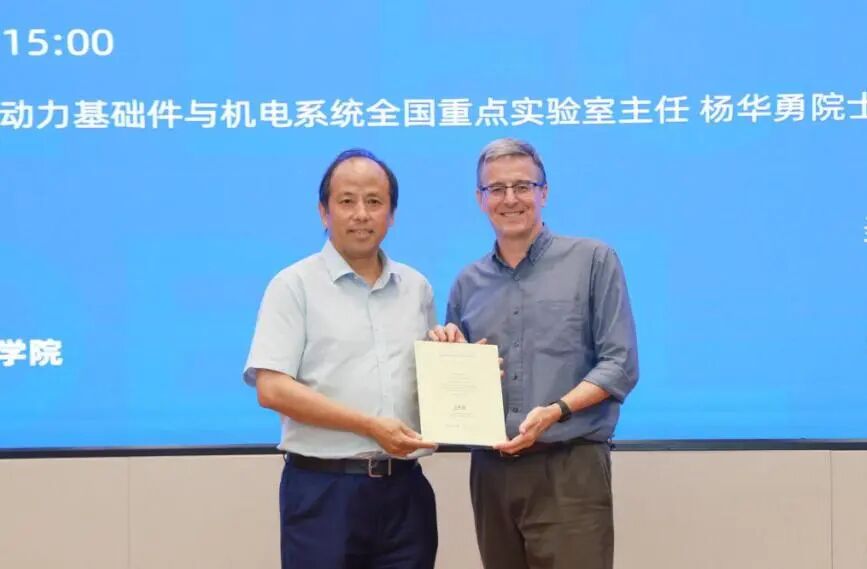
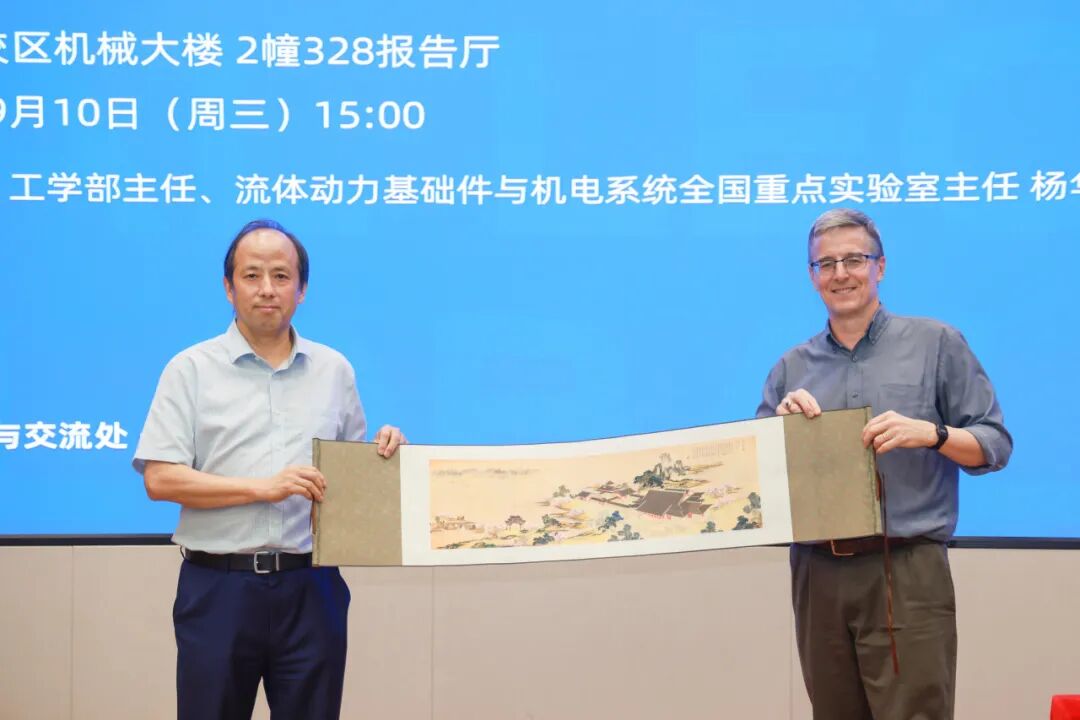
Following the Q&A, Academician Yang Huayong and faculty representatives presented Academician Rogers with a Certificate of Appreciation and a commemorative gift from the Overseas Distinguished Scholars Lecture Series, expressing their gratitude for his outstanding lecture.
Speaker Introduction

**John A. Rogers** is an internationally renowned materials scientist, physicist, and chemist. He is a member of all four U.S. National Academies—the National Academy of Engineering, the National Academy of Sciences, the National Academy of Medicine, and the American Academy of Arts and Sciences—and holds the title of Honorary Professor at Fudan University.
In September 2016, he joined Northwestern University, where he currently serves as the Louis Simpson and Kimberly Querrey Professor in the Departments of Materials Science and Engineering, Biomedical Engineering, and Medicine. He also holds adjunct professorships in Mechanical Engineering, Electrical and Computer Engineering, and Chemistry, and is the Director of the Querrey-Simpson Institute for Bioelectronics.
To date, Professor Rogers and his research team have published nearly 900 scientific papers and hold over 100 issued patents.
**Selected International Awards**
- 2009 – MacArthur Fellowship
- 2011 – Lemelson-MIT Prize
- 2013 – Smithsonian Award for American Ingenuity in the Physical Sciences
- 2018 – MRS Medal, Materials Research Society
- 2019 – Benjamin Franklin Medal, The Franklin Institute
- 2021 – Guggenheim Fellowship
- 2023 – IEEE Biomedical Engineering Award
Photo: School of Mechanical Engineering, Office of International Cooperation and Exchange
Text: Sun Yuheng, Xu Kaichen